
AI Scams Are Breaking the Way America Talks

Agnes Lindberg
Apr 20, 20264 min read
AI-powered scam calls and texts are pushing Americans into communication paralysis - and our 2026 survey shows it's costing them real money, real relationships, and real trust.
There was a time when a ringing phone meant opportunity. In 2026, it often means a calculation: Is this real? Is this a scam? Is there a deepfake on the other end of the line?
Our new 2026 Phone Fraud & AI Threat Survey, conducted with Centiment among 1,614 U.S. adults, confirms what millions already sense every time their phone buzzes. AI-powered scams have moved from a looming threat into an everyday reality - one that is costing people real money, eroding trust, and fundamentally changing how the country communicates.
The scale of the problem
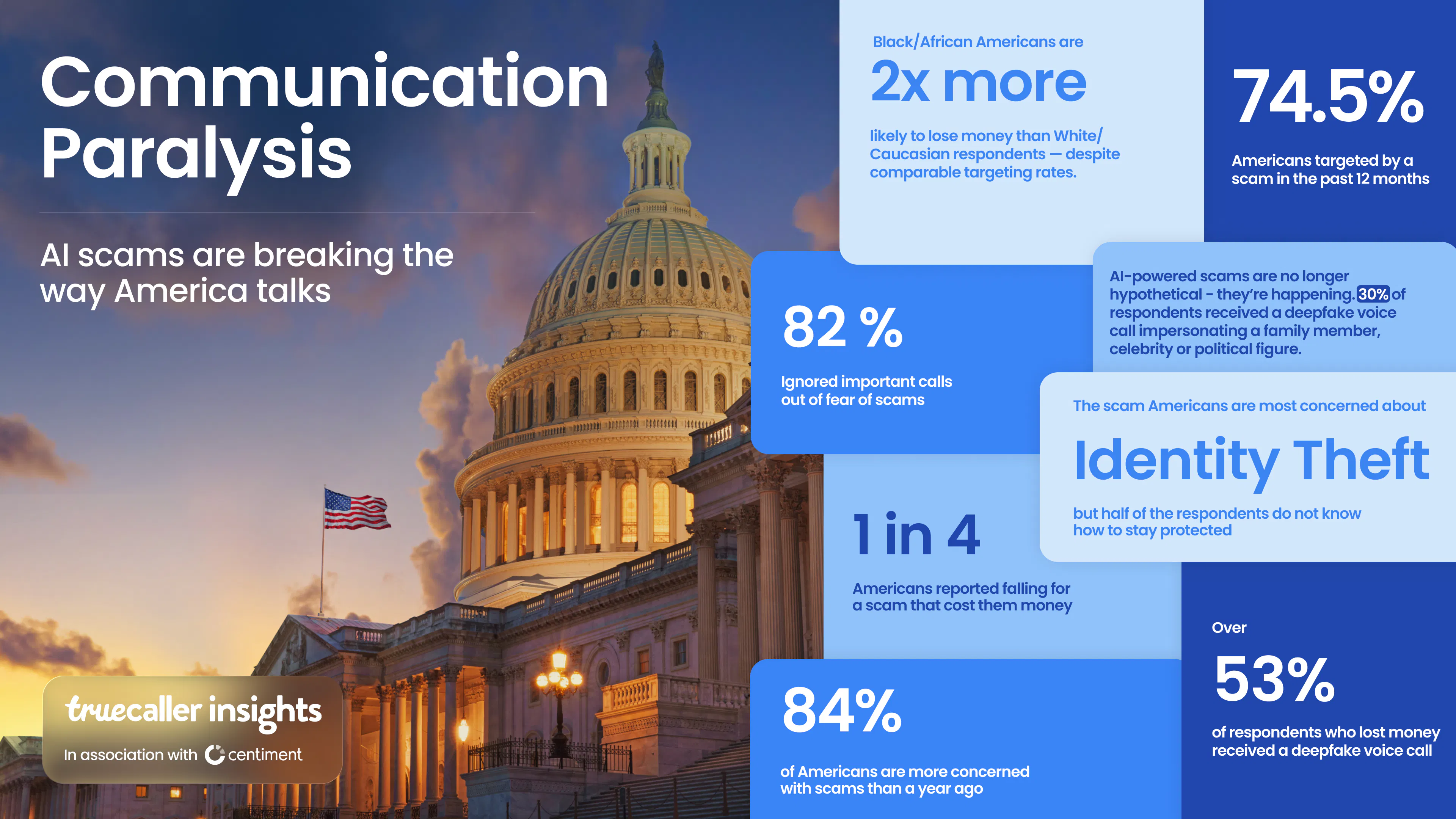
Three in four Americans (74.5%) were targeted by a scam call or text in the past year. Nearly one in three (29.7%) received a deepfake voice call impersonating a family member, celebrity, or public figure, and one in four (24.8%) lost money.
And people aren't oblivious: 78% know AI is being used against them, and 89% believe AI can already produce convincing scam calls today. The gut instincts that once protected people are now being weaponized against them.
Communication paralysis has arrived
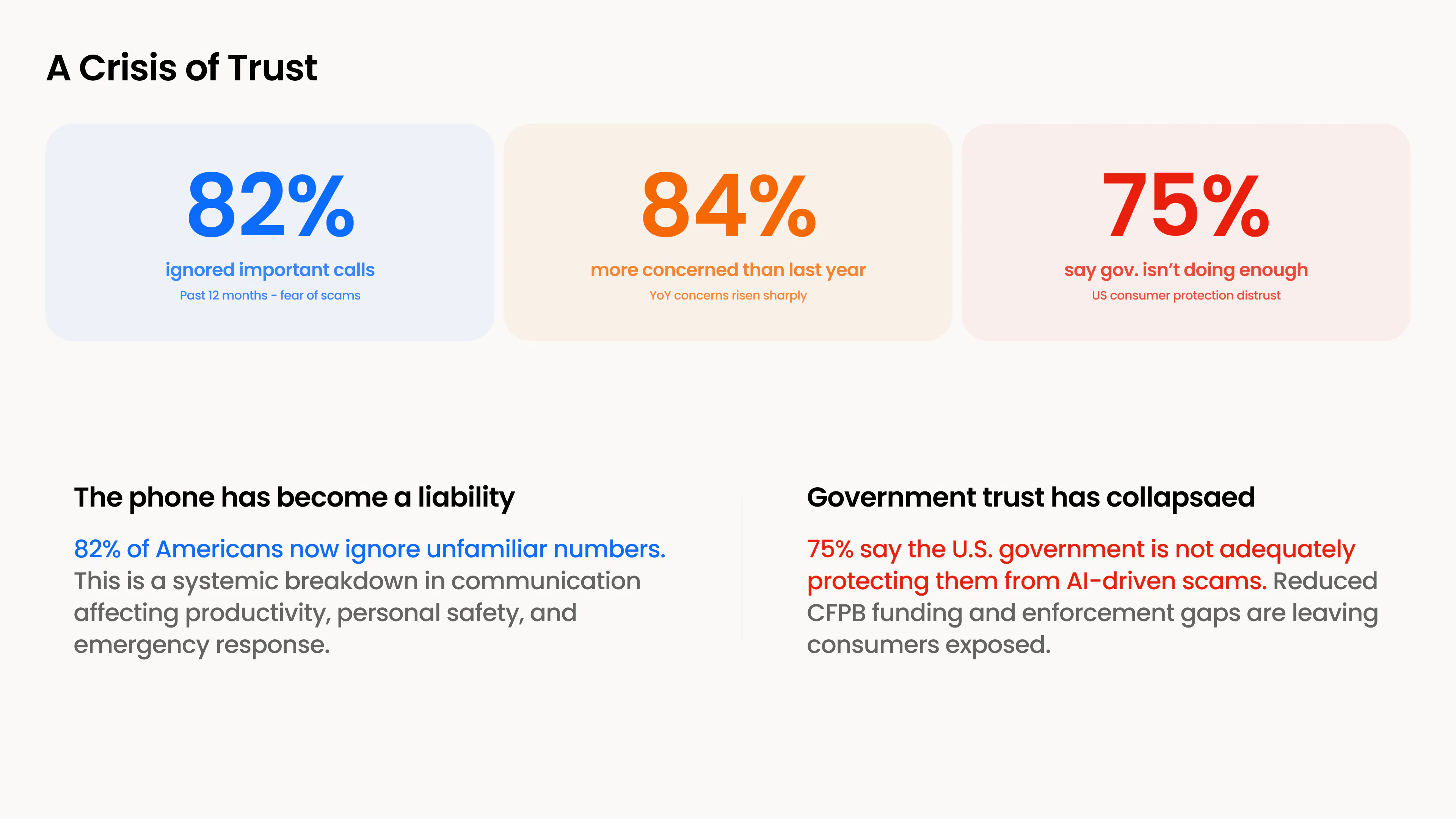
The most striking number in the survey is behavior. 82% of Americans say they have ignored important calls or texts in the past year for fear of a scam. That's up from 59% in our 2024 survey, a 23-point jump in just two years.
84% are more concerned about phone fraud than a year ago, and 81% worry about a younger or older relative falling victim. For the third of respondents who call and text for work, screening out unknown numbers carries a real professional cost. Americans aren't just screening spam anymore - they're screening out real life, turning a nuisance into a full-blown trust crisis.
Government trust hasn't filled the gap: 75% say the U.S. government isn't adequately protecting consumers from AI-driven scams, and 39% cite recent CFPB funding and staffing shifts as having undermined their confidence.
Where the scams are coming from
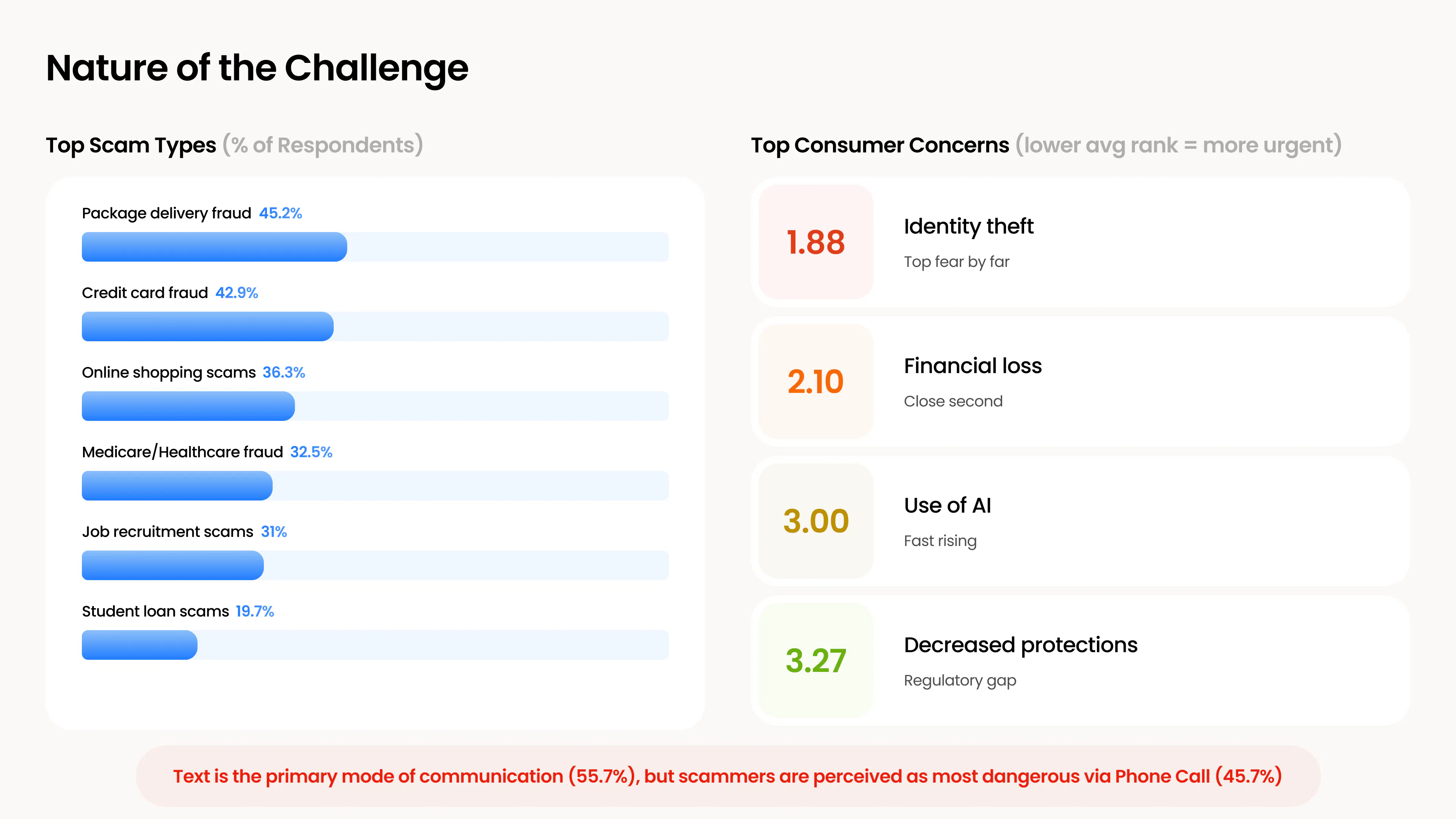
The scam landscape is broader than most people realize: 45.2% have seen package delivery scams, 42.9% credit card fraud, 36.3% online shopping scams, 32.5% Medicare or healthcare fraud, and 31% job recruitment scams. Text is the primary mode of communication for 55.7% of Americans, but 45.8% believe phone calls are where scammers do the most damage today.
Identity theft now tops Americans' scam-related worries for the year ahead, and 49.7% admit they wouldn't know how to protect their identity or recover funds if targeted tomorrow.
AI is making the damage worse
Deepfakes used to be all Hollywood, but now they are ringing your phone, and the effect on outcomes is striking. Among respondents who lost money to a scam, 53% had received a deepfake voice call. Among those who were targeted but kept their money, only 22% had. Deepfakes more than double the likelihood that a scam succeeds.
Who is most at risk
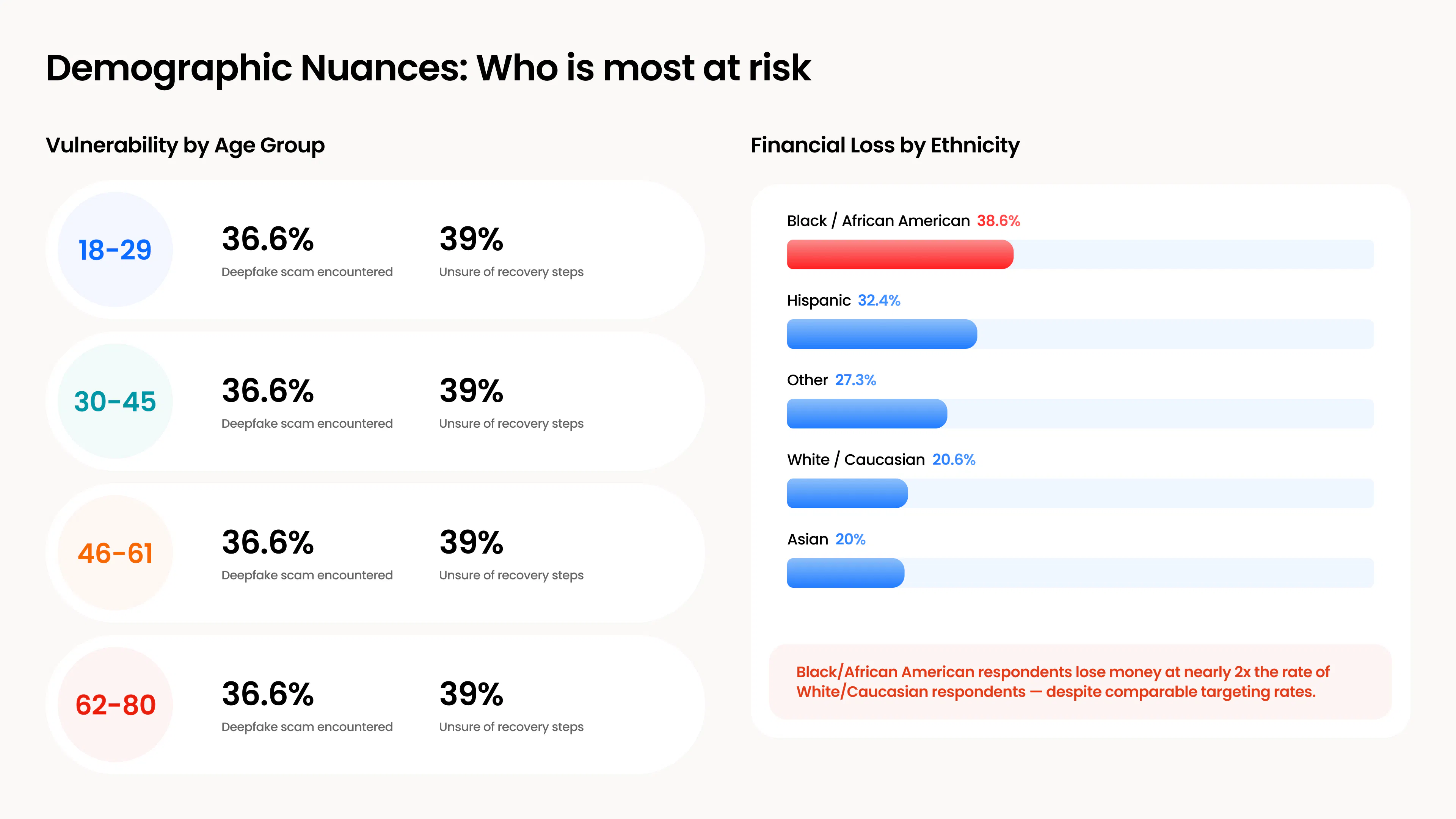
AI scams don't treat every American equally. 38.6% of Black/African American respondents who were targeted lost money - nearly twice the 20.6% loss rate among White/Caucasian respondents, with Hispanic respondents at 32.4%. Despite comparable targeting, some communities are absorbing far more of the damage.
And by age, every cohort from 18 to 80 reports similar vulnerability: roughly 36.6% have encountered a deepfake scam, and 39% are unsure of recovery steps. This is neither a “grandma problem” nor a “Gen-Z problem.”
Where the threat hits hardest
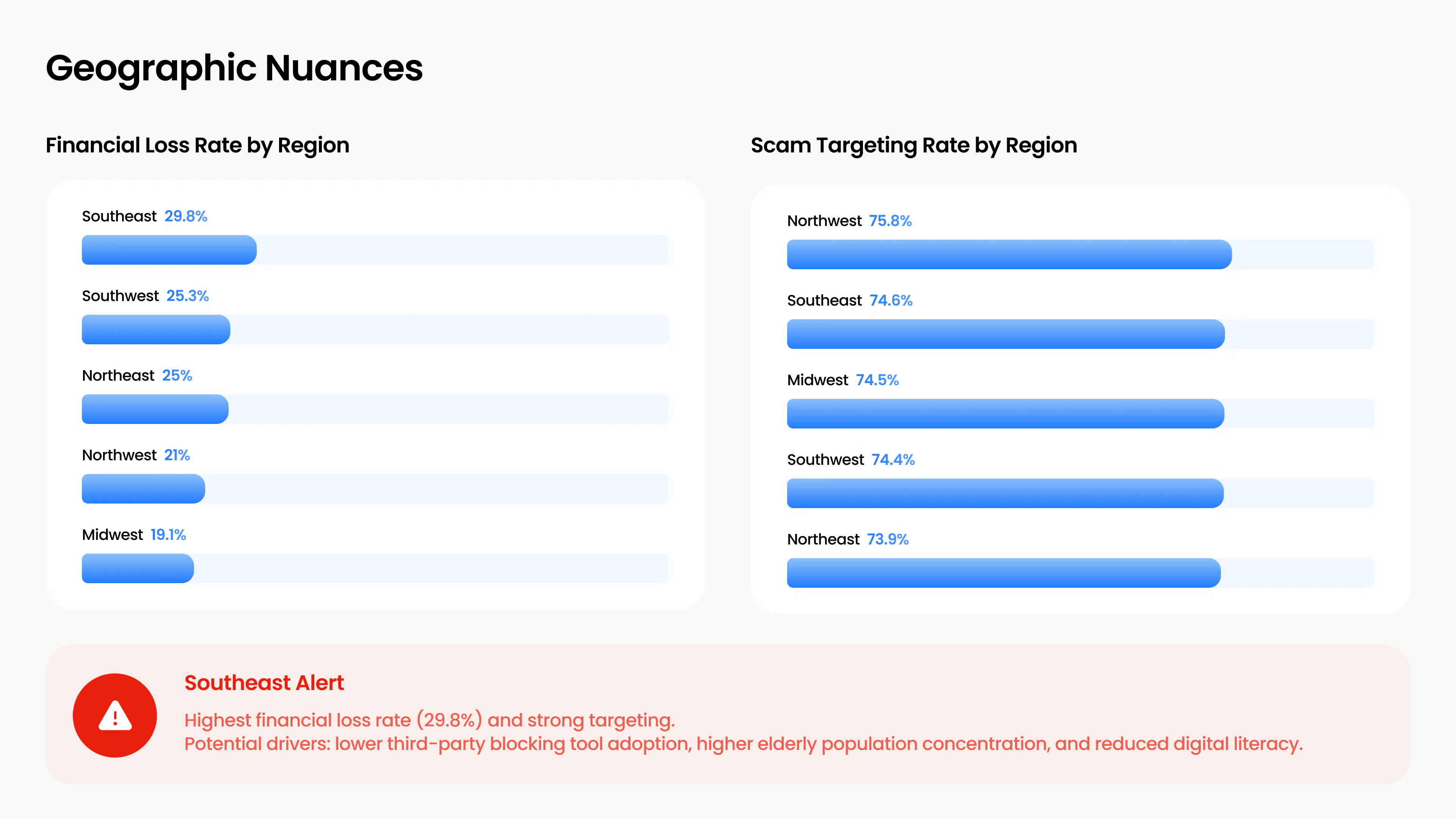
Targeting rates are remarkably flat across regions - 73.9% to 75.8%. Losses are not. The Southeast posts the highest loss rate at 29.8%, followed by the Southwest (25.3%) and Northeast (25%); the Midwest sits lowest at 19.1%. Lower adoption of third-party blocking tools, more older adults and digital-literacy gaps likely explain the Southeast gap.
Most Americans aren't reaching for tools that can help
63% of respondents rely only on their carrier's or phone's built-in tools to block scam calls and texts. When asked what matters most in a protection solution, they ranked automatic blocking of fraudulent calls first, followed by unknown caller identification — two functions where default tools often come up short. Encouragingly, roughly 64% say they would at least consider an AI-powered scam detection tool.
As AI grows more sophisticated, default tools simply can't keep up. People deserve protection that evolves faster than the threats they face.
Rebuilding trust, one call at a time
The scammer playbook hasn't changed even as the technology has: urgency, fear and speed. Slowing down remains one of the most effective defenses. A few practical moves that still work:
- Download a trusted Caller ID application.
- Never share sensitive personal or financial information over the phone.
- Avoid clicking unknown links in text messages.
- Register with the Do Not Call list.
- Report fraudulent calls whenever you receive them.
- Verify the identity of any caller — especially when they create urgency.
Take back the phone
Truecaller's mission has always been to build trust in communication and help people know who's really on the other end. With more than 500 million users worldwide, we're working to make sure picking up the phone doesn't have to feel like a gamble.
Ready to take back your phone? Download Truecaller today.
About the survey
The Truecaller 2026 Phone Fraud & AI Threat Survey is based on an online survey of 1,614 U.S. adults conducted by Centiment from February 20 to March 17, 2026. Find all earlier US reports on the Truecaller Insights page.
At Truecaller, we have made it our mission to build trust in communication. We do our best to help you navigate a world where fraud and unwanted communication are a part of your daily life. Stay updated about recent scams, and watch the latest YouTube videos on how you and the 500 million-strong community of people using Truecaller every month can stay protected. You'll find us on X, Facebook, Instagram, and TikTok.
Agnes Lindberg
Apr 20, 20264 min read