
India’s Spam Shield: Truecaller

Agnes Lindberg
Feb 11, 20265 min read
It’s time for the Truecaller Insights Report for India. As India’s digital economy continues to grow, spam and fraud operate at scale across the country. In 2025, the Truecaller community identified and blocked spam and fraud across thousands of crores of calls and messages nationwide.
Read on for the key highlights from the report.
Access the full report here: https://tclr.se/indiainsights2025
Understanding Spam, Fraud, and Trust at the Population Scale
In India, a phone call is rarely just a phone call.
It can be a bank alert.
A delivery update.
A loan reminder.
A missed opportunity.
Or it can be a scam.
In a rapidly growing economy like India on its journey towards Viksit Bharat, digital
communication has become the backbone of everyday life. With over 100 crore active phone connections, the nation is more connected than ever before, powering commerce, governance, and personal interactions at an unprecedented scale. As India accelerates its transition into a digitally empowered and globally competitive economy, trust in communication has emerged as a collective priority.
Every day, crores of people make small yet critical judgment calls: Should I answer? Should I trust this message? Do I need to act now? In an environment where opportunities and risks coexist, these decisions shape individual experiences and influence the larger ecosystem.
The report examines what those choices added up to in 2025, capturing what the Truecaller community experienced at scale.
Key findings from the report:
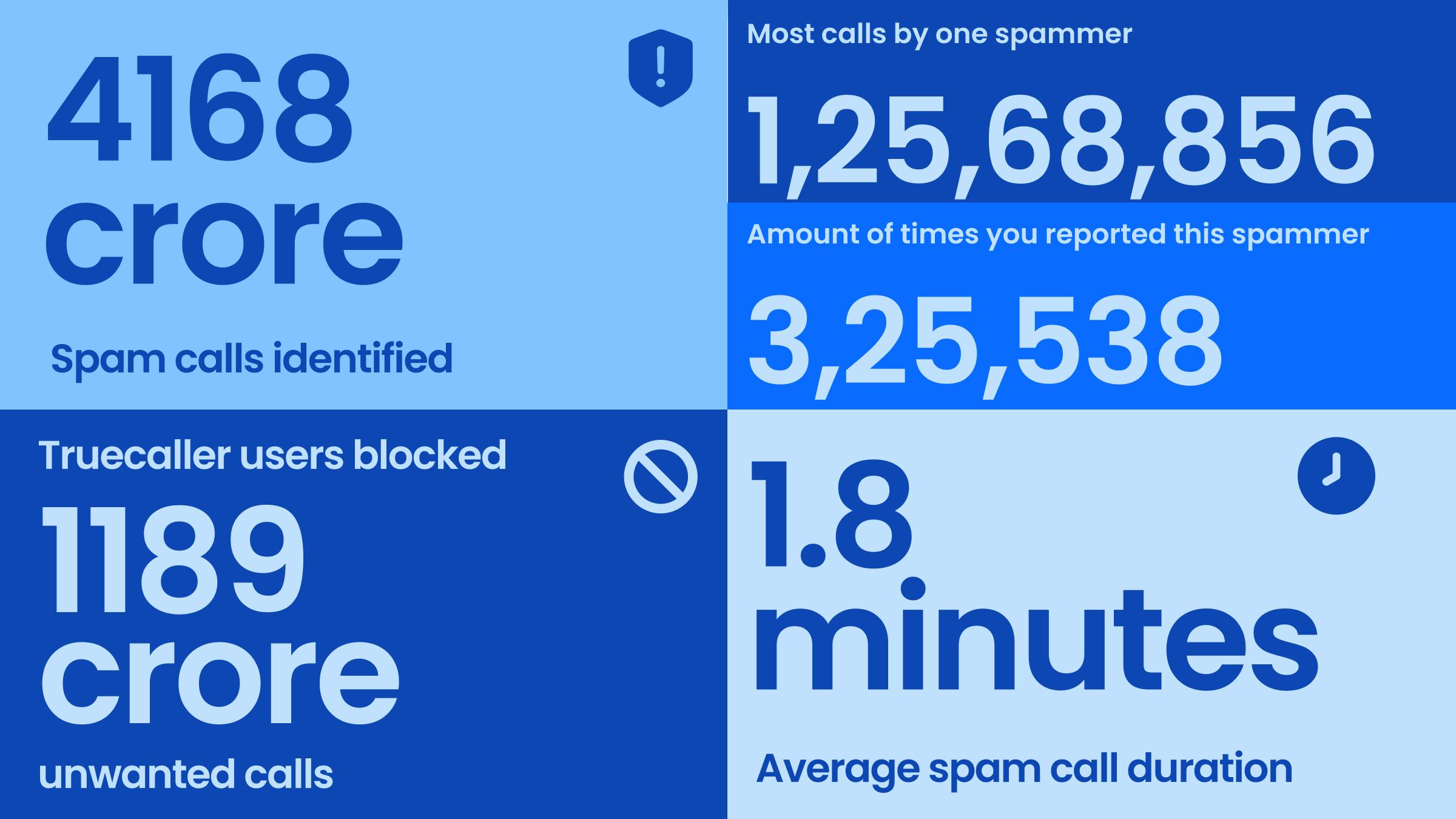
- 4,168 crore spam calls were identified across India. This number represents the full picture. It includes calls that were blocked, labelled, and ignored.
- The Truecaller community blocked 1,189 crore spam calls for people in India in 2025. On most days, many crores of calls never rang through.
- In a single day, the time saved from not speaking to spammers equals roughly 250 years of human life.
- 12,903 crore spam messages were identified in India.
- 770 crore fraud calls were identified in India.
What blocking spam actually changed for people
Blocking spam at scale changes everyday experiences in small but meaningful ways.
In 2025, the Truecaller community blocked 1,189 crore spam calls across India. On most days, many crores of unwanted calls never rang through. Based on an average spam call duration of 1.8 minutes, this protection meant people avoided spending over 21.7 lakh hours every day responding to spam, equivalent to around 250 years of human time saved daily.
Beyond time saved, blocking reduced interruptions during work, limited confusion for older users, and lowered exposure to urgency-driven mistakes that often precede fraud.
Scam and Fraud Identified by the Truecaller Community
Spam is not evenly distributed.
In 2025, the Truecaller community identified 770 crore fraud calls across India. These calls commonly impersonated banks, government authorities, payment platforms, and well-known brands, relying on familiarity and urgency to prompt action.
Most fraud attempts did not succeed. When they did, the consequences were immediate and financial, showing how everyday communication can become a point of real risk at population scale.
Strengthening protection before harm occurs
As spam and fraud continue to evolve, so must the systems designed to stop them. The patterns observed in 2025 point to a clear shift: scams are becoming more fluent, more routine, and faster to adapt.
In 2026, Truecaller is focused on strengthening protection before harm occurs across four key areas.
Reducing exposure at the household level
Spam and fraud rarely affect just one person. Features such as Family Protection are designed to extend safeguards across connected family members, particularly older users and first-time smartphone adopters, where the risk of harm is higher.
Real-time risk detection during calls
As scam scripts become more convincing, static labels alone are no longer enough. AI Call Scanner is being strengthened to surface warnings during live interactions, helping users recognise high-risk situations as they unfold.
Faster identification of emerging fraud patterns
Scam campaigns adapt quickly across numbers, scripts, and channels. New detection systems focus on behavioural patterns over time, allowing fraud activity to be identified earlier — even as individual numbers change.
Collective awareness through community signals
Scam activity often first appears as near-misses: calls that feel suspicious or messages that raise concern. Scamfeed in the Truecaller app allows users to share these experiences in real time, helping others recognise threats sooner. This collective awareness adds context that no single signal can provide.
As protection systems evolve, the types of scams people encounter will continue to change - particularly as identity signals and automation become more widespread.
Looking ahead
As scams increasingly combine calls and messages and begin to sound routine, protection depends more on context — how a number behaves over time and how others experience it.
The Truecaller community continues to play a central role in identifying risks early and strengthening trust as communication in India continues to grow.
The Truecaller Way: Practical Steps to Reduce Risk
- Be cautious with calls or messages that create urgency, especially those related to banking, KYC updates, account suspension, or law enforcement. Take time to verify before responding.
- Avoid responding to calls or messages that are flagged as spam or suspicious by community reporting or automated detection systems.
- Do not click on unknown or unexpected links received via SMS or messaging apps, particularly when they involve financial actions. When in doubt, contact the organisation directly using official contact details.
- Never share sensitive information such as OTPs, PINs, passwords, Aadhaar numbers, PAN details, or bank information over a call or message. Banks, financial institutions, and government agencies do not request this information in this way.
- Be cautious about requests to install apps or share screen access, especially if prompted during a call or via a message. Only install apps from official app stores.
- Treat offers, refunds, or requests that arrive unexpectedly - especially from personal numbers claiming to represent organisations - with scepticism.
Notes & Methodology
The data in this report was aggregated anonymously from metadata and spam classification signals for all Truecaller users in India from January 1st, 2025, to December 31, 2025. During this period of time, we helped our users in India identify 4,168 crore calls and helped identify 12,903 crore spam messages. Spam blocking is based on active community reporting by people using Truecaller.
The insights presented reflect patterns observed within this dataset and are intended to provide visibility into trends in spam and fraud activity at a national level. They should not be interpreted as precise measurements of all spam or fraud activity across India, nor as assessments of individual users, organisations, or regions.
References to emerging scam patterns are indicative and forward-looking, based on observed behaviour and known adaptation trends. They do not constitute predictions or guarantees of future activity.
At Truecaller, we have made it our mission to build trust in communication. We do our best to help you navigate a world where fraud and unwanted communication are a part of your daily life. Stay updated about recent scams, and watch the latest YouTube videos on how you and the 450 million-strong community of people using Truecaller every month can stay protected. You'll find us on X, Facebook, and Instagram. For all things Truecaller, visit the TrueTalks Community.
Agnes Lindberg
Feb 11, 20265 min read