
The Machine Era of Spam Calls: The Ten Most Spammed Countries in the World
Agnes Lindberg
May 4, 20265 min read
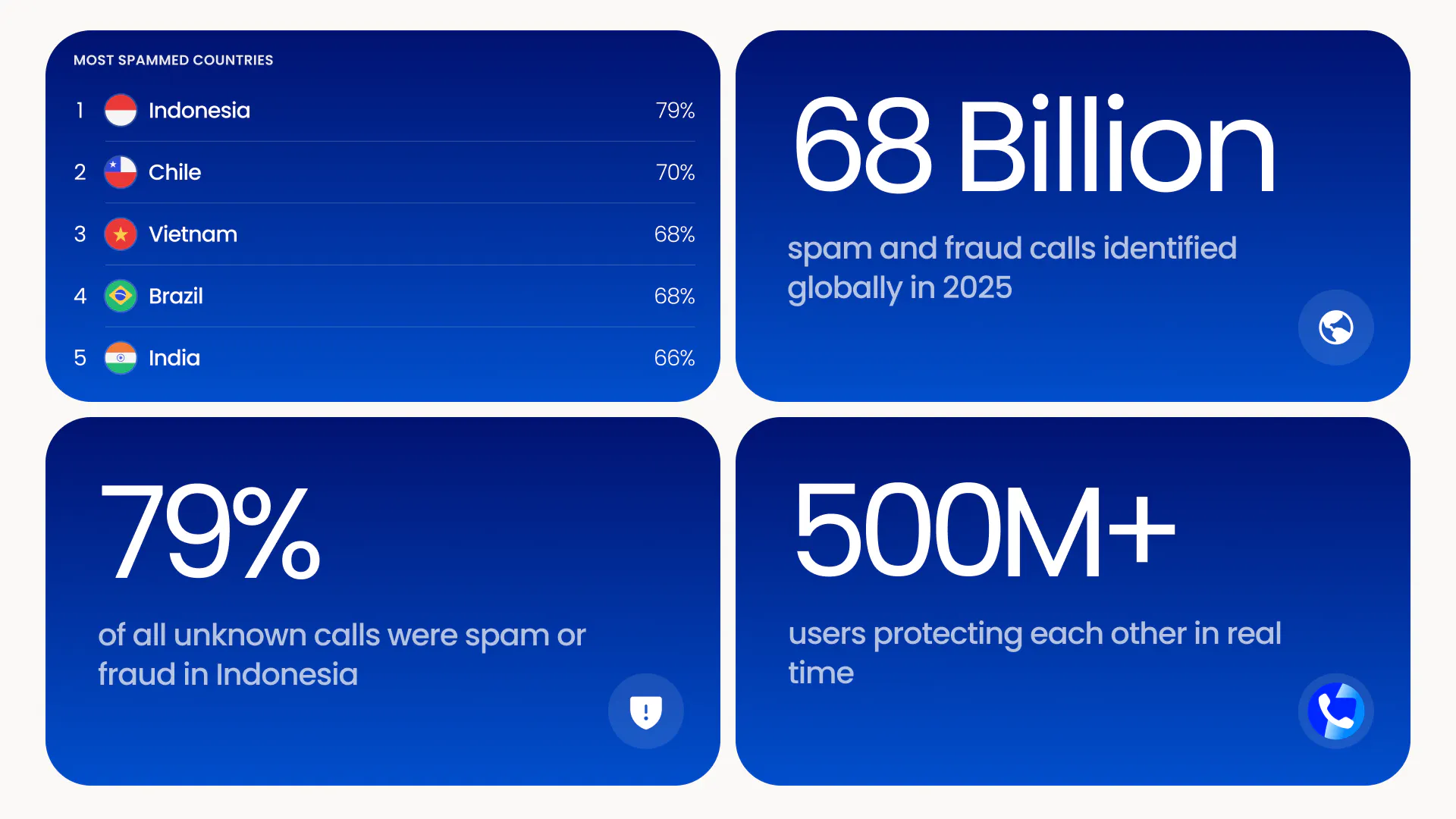
It's time for the Global Insights Report. For the first time since 2021, Truecaller reveals which countries are being hit hardest by spam and fraud calls. In 2025, we identified 68 billion spam and fraud calls globally - and the patterns show a world where automated fraud has reached a scale we have never seen before.
Read on for the key highlights from the report.
Access the full report here: https://tclr.se/2025InsightsReport
The Global Picture
A phone call used to mean a person on the other end. That's no longer a safe assumption.
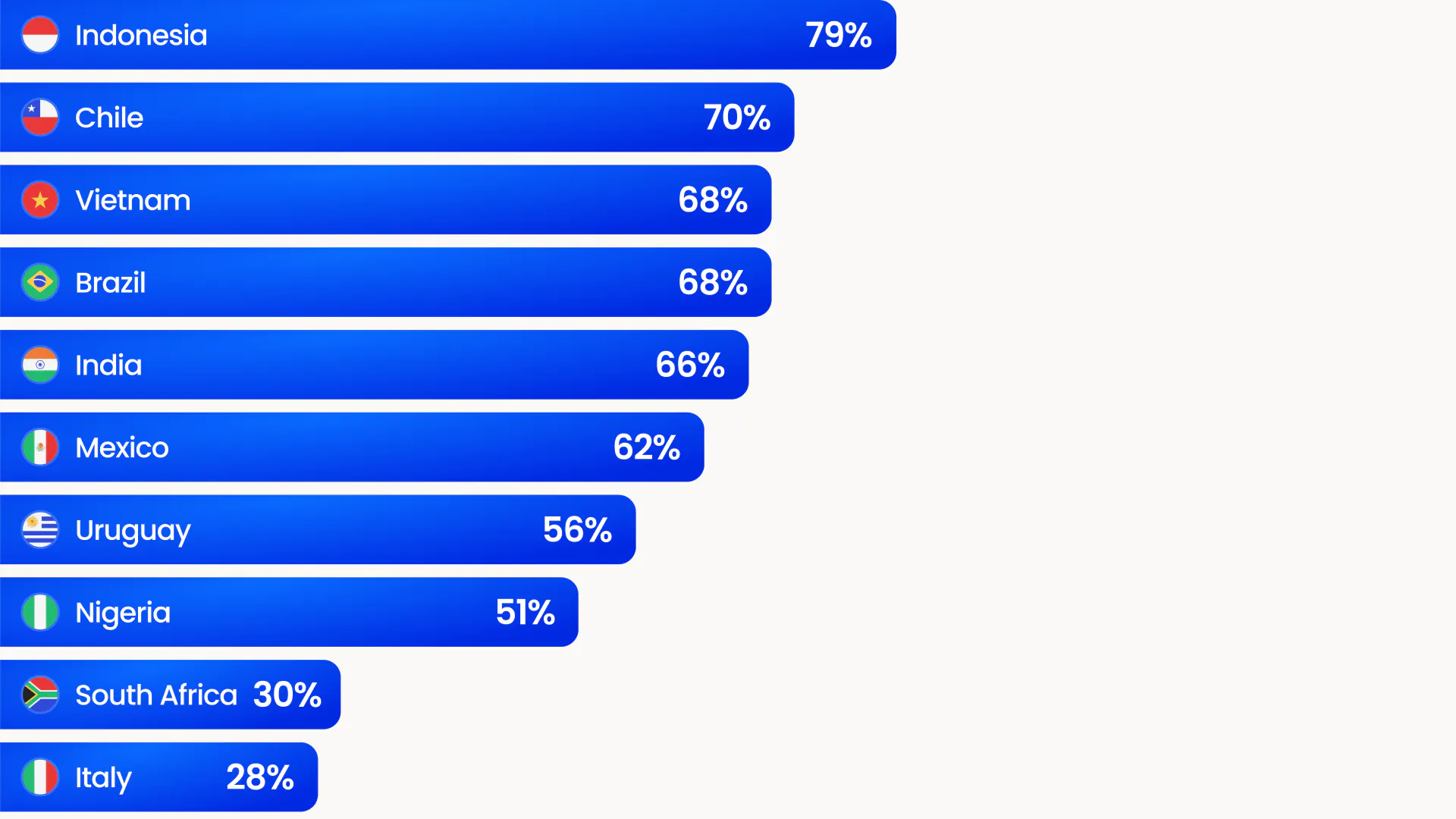
Indonesia is the most spammed country in the world. In 2025, 79% of all unknown calls were spam or fraud - nearly 4 in 5 calls. Chile follows at 70%, up from 51% in just six months. Vietnam, Brazil, and India round out the top five.
The Machine Era of Spam Calls
Spam has moved from human callers to automated systems running at a scale no individual could match. Across the most heavily targeted markets, the majority of unknown calls are now generated by machines. 500 million users protecting each other in real time is what makes it possible to map this at a global scale.
How Fraud Adapts Locally
The ranking tells you where the problem is worst. The category data tells you what is actually happening. In Chile, debt collection accounts for 38% of all spam - the highest concentration of any single category in any market globally. In Indonesia and Mexico, over 40% of spam calls impersonate financial institutions. In Brazil and Nigeria, operator-linked calls dominate, making it hard to tell a genuine carrier message from fraud. Find all the categories from all countries on the top ten list in the full report.
2021 vs. 2025
In 2021, Truecaller had 300 million users and helped identify 37.8 billion spam calls globally. By 2025, that community had grown to 450 million users and identified over 68 billion spam and fraud calls. Nearly double the volume. And on March 31, 2026, Truecaller crossed half a billion monthly active users, with more than 150 million of those outside of India.
That global shift shows in the data. In 2021, Truecaller was still primarily an India story. Today, the fastest growth is in Latin America, Southeast Asia, and Africa — exactly the regions that dominate the 2025 spam rankings. As the scale of spam has increased, more people are turning to Truecaller to manage it.
The category mix shifted too. In 2021, Sales calls dominated most markets. By 2025, two significant structural shifts emerged. Across Europe and Africa, Operator-linked outreach has transitioned from a marginal category to a top-three dominance, where automated systems at the carrier level generate volumes that users struggle to distinguish from legitimate service updates. Meanwhile, in Chile, Debt Collection has eclipsed Sales as the primary category—surging from 7% in 2021 to 38% in 2025—a definitive signal that automated dialers are now being utilized as instruments of financial pressure rather than mere sales outreach.
The machine didn’t replace the spammer. It gave them reach they never had before.
Looking Ahead to 2026
The data describes where spam and fraud calls are today. What comes next is already visible.
AI-generated voice calls are becoming harder to distinguish from real ones. Scam scripts are adapting faster than ever. The patterns observed in 2025 point to two clear shifts: people are seeing more information about who is calling them, and scam operations are becoming easier to run at scale through automation. For legitimate businesses, the unknown call has become a liability. A real company calling a real customer has to work harder than ever to be heard.
With over 500 million users and over a decade of identity and reputation data, Truecaller holds one of the world's most comprehensive trust graphs, built from billions of real interactions across calls, messages, and community signals. In 2026, the focus is on continuing to use that base to reduce risk by strengthening detection, context, and collective signals across calls and messages. That means expanding protection across four areas:
Reducing exposure at the household level.
Spam and fraud rarely affect just one person. Family Protection is designed to extend safeguards across connected family members, particularly older users and first-time smartphone adopters, where the risk of harm is higher.
Real-time risk detection during calls.
As scam scripts become more fluent and convincing, call-time warnings matter more than static labels. AI Call Scanner is being strengthened to surface risks during live interactions, helping users recognise high-risk situations as they unfold.
Faster identification of emerging fraud patterns.
Scam campaigns adapt quickly across numbers, scripts, and channels. New detection systems focus on behavioural patterns over time, allowing fraud activity to be identified earlier - even when individual numbers change rapidly.
Collective awareness through community signals.
Scam activity often appears first as near-misses. Scamfeed allows users to share and surface suspicious experiences in real time, helping others recognise threats sooner. This collective awareness adds a layer of context that automated detection alone cannot provide.
The problem is getting harder. The tools to fight it are getting better.
The complete top 10 ranking, regional breakdowns, and the full category analysis are available here: https://tclr.se/2025InsightsReport
Notes & Methodology
The data in this report was aggregated anonymously from metadata and spam classification signals for all Truecaller users globally from January 1st, 2025, to December 31, 2025.
The insights presented reflect patterns observed within this dataset and are intended to provide visibility into trends in spam and fraud activity at a global and national level. They should not be interpreted as precise measurements of all spam or fraud activity across the world, nor as assessments of individual users, organisations, or regions.
References to emerging scam patterns are indicative and forward-looking, based on observed behaviour and known adaptation trends. They do not constitute predictions or guarantees of future activity.
At Truecaller, we have made it our mission to build trust in communication. We do our best to help you navigate a world where fraud and unwanted communication are a part of your daily life. Stay updated about recent scams, and watch the latest YouTube videos on how you and the 500 million-strong community of people using Truecaller every month can stay protected. You'll find us on X, Facebook, Instagram, and TikTok.
Agnes Lindberg
May 4, 20265 min read